Teenagers don't have a focus problem. They have a motivation transfer problem

68% showed observable classroom focus improvements in 12-week trial

UX DesignProduct Strategy
Teenagers don't have a focus problem. They have a motivation transfer problem

Teenagers don't have a focus problem. They have a motivation transfer problem

68% showed observable classroom focus improvements in 12-week trial

Teenagers don't have a focus problem. They have a motivation transfer problem

Teenagers don't have a focus problem. They have a motivation transfer problem

68% showed observable classroom focus improvements in 12-week trial

UX DesignProduct Strategy
Teenagers don't have a focus problem. They have a motivation transfer problem

Teenagers don't have a focus problem. They have a motivation transfer problem

68% showed observable classroom focus improvements in 12-week trial

UX DesignProduct Strategy
Teenagers don't have a focus problem. They have a motivation transfer problem

PROJECT OVERVIEW

PROJECT OVERVIEW

PROJECT OVERVIEW

A pre-seed startup, and one question:

can you build focus without surveillance?

An EdTech startup needed proof that teenagers could build focus habits without surveillance, but teens averaged 7.5 hours daily screen time with 30% shorter attention spans. I designed a 12-week progressive app using identity-based persuasion and gaming rewards.

An EdTech startup needed proof that teenagers could build focus habits without surveillance, but teens averaged 7.5 hours daily screen time with 30% shorter attention spans. I designed a 12-week progressive app using identity-based persuasion and gaming rewards.

Team

1 Product Designer

1 BE engineer

1 FE engineer

MY Role

User research & analysis

UX and UI design

Usability testing

Timeline

March 2024 - June 2024

84 %

Retention validated

28 of 32 users; all 12 weeks Industry average: 45–60%

68 %

External validation

Teacher-validated observation, not self-reported

91 %

ICO compliant

Over screen monitoring
Zero privacy complaints

72 %

SDT theory validated

By week 12, from gaming
rewards to focus satisfaction

Team

Product Designer (Me)

1 BE engineer

1 FE engineer

My Role

User research & analysis

User research

UX and UI design

Usability testing

Timeline

12 weeks · 2024

84 %

Completed the full programme

28 of 32 users. All 12 weeks Industry average: 45–60%

{ Retention validated }

68 %

Classroom focus improvement

Teacher-validated observation. Not self-reported

{ External validation }

91 %

Preferred identity verification

Over screen monitoring. Zero privacy complaints

{ ICO compliant }

72 %

Shifted to intrinsic motivation

From gaming rewards to focus satisfaction

{ SDT theory validated}

THE CHALLENGE

THE CHALLENGE

The existing market wasn't failing to engage teenagers. It was actively making things worse.

The teen productivity app market suffered from three critical failures; all rooted in fighting teenage psychology rather than working with it.

App store reviews cited 'parental surveillance' in 62% of 1-star ratings.

7.5h AVERAGE

The scale of the distraction

Daily Screen Time

40% increase over decade

7.5h AVERAGE

The scale of the distraction

Daily Screen Time

40% increase over decade

89% ABANDON RATE

Ineffective UX

Market Failure

Existing focus apps (2wk limit)

89% ABANDON RATE

Ineffective UX

Market Failure

Existing focus apps (2wk limit)

PREVIOUS SPAN CURRENT SPAN (-30%)

Cognitive Degradation

Attention Span

The measurable harm

PREVIOUS SPAN CURRENT SPAN (-30%)

Cognitive Degradation

Attention Span

The measurable harm

{01} — Problem

Watching teenagers didn't build trust, it destroyed it.
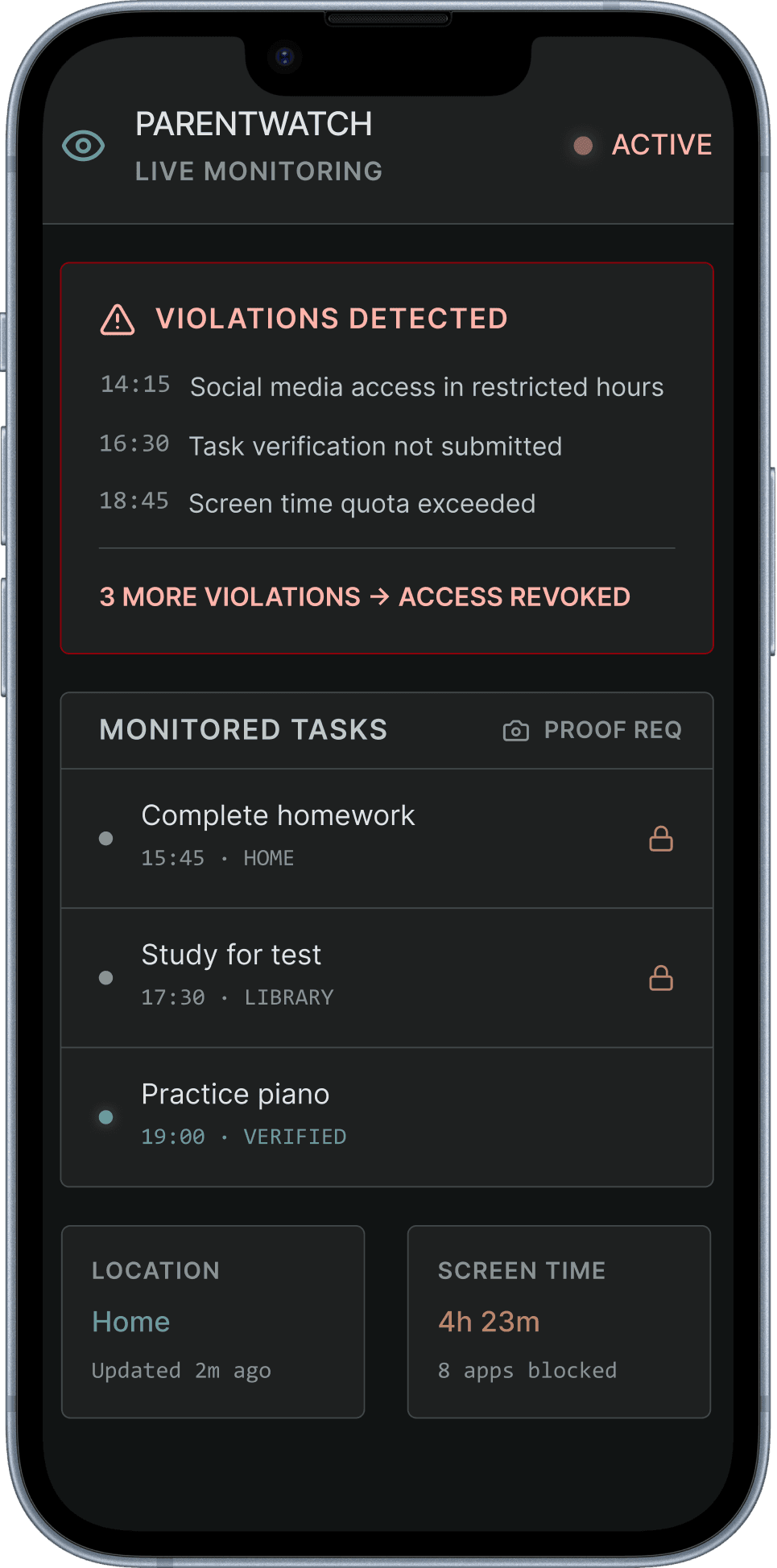
The act of being watched created a counter-motivation to subvert the system.

Teens felt accused, not supported, and found workarounds within days of installation.

The act of being watched created a counter-motivation to subvert the system.
Teens felt accused, not supported, and found workarounds within days of installation.

0%

Uninstall within first month

0%

Uninstall within first month

0%

Uninstall within first month

Punishment is the only response
Homework requires photographic proof
Punishment is the only response
Homework requires photographic proof

{02} — Problem

Every restriction created a workaround. The conflict moved into the home

Identity formation in ages 14-17 centres on independence. Externally imposed restrictions trigger the exact behaviours they intend to prevent.

Blocking apps shifted behaviour to other devices. Family conflict became the primary outcome, not the focus.

0.0x

Family conflict increase

0x

Family conflict increase

0x

Family conflict increase

3 bypass methods - 83 minutes
The workaround worked
3 bypass methods ; 83 minutes
The workaround worked

{03} — Problem

Self-reporting is too easy to fake

When gaming time was the reward, self-reporting became a system to game.

Rewards became tokens for lying. The product actively incentivised dishonesty through its own design

When gaming time was the reward, self-reporting became a system to game. Rewards became tokens for lying. The product actively incentivised dishonesty through its own design

0%

Of competitor apps, used single checkbox patterns

0%

Of competitor apps, used single checkbox pattern

0%

Of competitor apps, used single checkbox pattern

4 tasks. 2 minutes
4 tasks. 2 minutes

 The strategic breakthrough

Gaming isn't the enemy of focus; it's the missing motivation bridge.
Every previous solution fought teenage psychology. The opportunity was to work with it.

Gaming isn't the enemy of focus; it's the missing motivation bridge.
Every previous solution fought teenage psychology. The opportunity was to work with it.

RESEARCH

RESEARCH

RESEARCH

Three assumptions research demolished before we built anything

32 interview transcripts. 3 schools. 6 weeks of observation. These weren't findings; they were design mandates.

32 interview transcripts.
3 schools. 6 weeks of observation.
These weren't findings; they were design mandates.

1

We assumed monitoring would create accountability. Instead, being watched created a direct motivation to subvert the system. Surveillance didn't just fail to build trust, it actively destroyed it.

We assumed monitoring would create accountability. Instead, being watched created a direct motivation to subvert the system. Surveillance didn't just fail to build trust, it actively destroyed it.

2

We assumed industry-standard 25-minute sessions were a reasonable starting point. Prototype testing showed average teen focus capacity was 5–8 minutes. We were designing for a user who didn't exist yet.

We assumed industry-standard 25-minute sessions were a reasonable starting point. Prototype testing showed average teen focus capacity was 5–8 minutes. We were designing for a user who didn't exist yet.

3

We assumed gaming was the competitor for attention. Research showed gaming's mechanics, progressive challenge, visible rewards, identity progression, were exactly what sustained focus needed to look and feel like.

We assumed gaming was the competitor for attention. Research showed gaming's mechanics, progressive challenge, visible rewards, identity progression, were exactly what sustained focus needed to look and feel like.

Key insight

Key insight

Being watched felt like being accused

Deep Contextual enquiry with 28 families revealed teens viewed screen-time trackers as 'parent spy apps'. When shown prototype monitoring, 21 of 28 teens said they'd intentionally bypass it. Parents confirmed this created 3.2× more conflicts.

Led to:

Identity-based verification replacing surveillance monitoring

Surveillance 3.2× conflict surge Identity Verification

Most teens couldn't even start, because we asked too much too soon

Prototype testing with 32 teens showed baseline focus capacity averaged 5-8 minutes, not industry-standard 25 (Pomodoro). Starting users at 25 minutes created 77% Day-1 failure rate. Users needed personalised starting points.

Led to:

Adaptive baseline assessment replacing fixed session length

Adaptive Baseline 25m Standard 5–8m Adaptive 77% Day-1 Failure Rate On Fixed Sessions

They didn't quit. They disappeared, and shame kept them away

Beta testing revealed users who lapsed for 1+ weeks rarely returned. Early prototype exit interviews showed shame-based messaging ('You broke your streak!') triggered permanent abandonment. Users wanted recovery paths, not punishment.

Led to:

Adaptive recalibration reducing session length 20-30% after lapses

Lapse Recovery Engagement Lapse Abandonment Recovery 68% Complete Recovery With Adaptive Recalibration

The Art of Sailing

When shown a future-self prompt during research sessions, 78% participants described honesty differently. Identity connection shifted integrity from a rule to be followed to a standard they held for themselves, internal, not enforced.

Led to:

Future-self visualisation feature; avatar evolution showing current vs potential focus identity

Identity · Integrity Rule Self 78% described honesty differently Current Potential Future-Self Visualisation

DESIGN DECISIONS

DESIGN DECISIONS

DESIGN DECISIONS

Three decisions that could only
come from the research

Three decisions that could only come from the research

{01} — Decision

Reflection, not cameras. Honesty by design.

91% of beta users chose reflection over camera monitoring when offered the choice.

Not because we mandated it, because surveillance made teenagers feel accused rather than supported. That finding invalidated the entire monitoring-based approach and forced a different question: what if honesty came from inside the user, not extracted from them?

I built a reflection system where users answered questions like "What did you study? What distracted you?" after each session. Natural language processing assessed specificity against generic claims and awarded gaming time proportionally to both session duration and reflection depth. Transparent scoring shown in real time, users saw their quality score and understood exactly why the system responded as it did.

High-quality responses auto-approved. Borderline cases triggered one follow-up question. Low-quality prompted more detail. No hidden thresholds.

84%

reported reflection questions made them complete genuine sessions rather than gaming the system.

Quality score shown in real time
No black box
Quality score shown in real time
No black box
Reward proportional to reflection depth
Not session duration alone
Reward proportional to reflection depth
Not session duration alone
Reward proportional to reflection depth
Not session duration alone
Question requires genuine recall
Identity framing
Question requires genuine recall
Identity framing

{02} — Decision

Progressive Trust Architecture

ICO compliance for minors wasn't a checkbox; it restructured the entire verification model.

Designing for a regulated user group meant starting from minimum data collection and working outward, not starting from surveillance and retrofitting privacy controls afterwards. The constraint forced better design.

I built tiered verification where consistent behaviour unlocked richer features, always with explicit consent at each progression point. One-tap opt-outs for every feature. Scheduled privacy modes. Visible data deletion. Users earned "Trusted Focus" status through authentic reporting, which reduced verification requirements progressively over the 12-week arc.

The simpler build, full data access or no access, sat uncomfortably with ICO's age-appropriate design principles for minors. Granular progressive control was not a compromise; it was the only responsible architecture.

When trust is earned rather than assumed, users invest in protecting it. The tier system became aspirational, teenagers wanted to maintain their own system reputation.

91%

of beta users preferred identity-based verification over monitoring when offered the choice. Trust progression became a motivation driver rather than a compliance hurdle. Privacy architecture subsequently set the standard for all future products.

91%

of beta users preferred identity-based verification over monitoring when offered the choice. Trust progression became a motivation driver rather than a compliance hurdle. Privacy architecture subsequently set the standard for all future products.

Earned status
verification reduces as behaviour accumulates
Earned status
verification reduces as behaviour accumulates
ICO compliance
user controls every data point collected
ICO compliance
user controls every data point collected

{03} — Decision

Gaming as Motivation Bridge

The riskiest decision in the project was designing a product that actively works to make itself unnecessary.

Gaming rewards were never the goal, they were the bridge. External motivation that never steps aside eventually suppresses the intrinsic motivation it was meant to build. That failure mode shaped every reward decision from day one.

Weeks 1–4: gaming time as direct reward (25 min focus = 45 min gaming).
Weeks 5–8: skill mastery recognition introduced alongside gaming rewards.
Weeks 9–12: intrinsic focus satisfaction foregrounded, gaming retained as optional rather than primary.
The reward ratio shifted from 3:1 to 1:1, the mechanism by which the bridge would eventually dissolve itself.

The product was designed with a built-in exit strategy from its own motivational scaffolding.

72%

of beta users showed a measurable shift from external to internal motivation drivers by week 12. Reward ratio management prevented gaming dependency, the exact failure mode the product was built to avoid.

72%

of beta users showed a measurable shift from external to internal motivation drivers by week 12. Reward ratio management prevented gaming dependency, the exact failure mode the product was built to avoid.

Gaming time should be earned
the ratio itself trains restraint
Gaming time should be earned
The ratio itself trains restraint
12-week arc visible on day one
user understands where they are going before they start
12-week arc visible on day one
User understands where they are going before they start
WEEK 1 STATE
WEEK 1 STATE
WEEK 1 STATE
App tells user when to focus
Reward is gaming time prominently displayed before session starts
App tells user when to focus
Reward is gaming time prominently displayed before session starts
WEEK 12 STATE
User decides when to focus
Reward is the streak gaming present but secondary and optional
WEEK 12 STATE
User decides when to focus
Reward is the streak gaming present but secondary and optional

 What these proves

The same home screen, 12 weeks apart. The app did not add features, it stepped back. Push notifications off. Gaming reward demoted. CTA changed from command to invitation. This is the exit strategy made visible: the product designed itself to become unnecessary.

ITERATIONS

ITERATIONS

Three moments where the obvious answer was wrong

These iterations reveal how user feedback and constraints shaped the final solution.

These iterations reveal how user feedback and constraints shaped the final solution.

{01} — Discovered Week 4 beta testing

40% quit mid-session. Punishing them made it 60%

Mid-session abandonment

Initial beta testing showed 40% of users started focus sessions but abandoned them before completion. The instinctive fix, losing gaming credits for quitting, pushed abandonment higher, not lower.

/

Penalty screen

Session abandoned → alarming banner → "You lost 15 gaming minutes" → forced return to home. Punishment created the exact reactance we were trying to avoid, teens quit the app rather than the session.

/

Adaptive recovery

Mid-session break option, temporary difficulty reduction, Path to Recovery visualisation showing the return route. Setbacks treated as designed-for events, not failures requiring punishment.

Rejected
Rejected
Rejected
Tested Week 4
abandonment climbed from 40% to 60%
Tested Week 4
Abandonment climbed from 40% to 60%
Shipped
Shipped
Lapse reframed
as expected event not failure
Lapse reframed
As expected event not failure

35%

35%

reduction in permanent abandonment after shipping the adaptive recovery approach.

reduction in permanent abandonment after shipping the adaptive recovery approach.

{02} — Discovered Day 1 prototype testing

77% failed day one, because we started them in the wrong place.

Onboarding start point

/

Fixed 25-minute opening session

The industry standard, same starting point for every user regardless of actual focus capacity. Day-one failure at this rate destroys motivation before habit formation has any chance to begin.

/

Personalised baseline assessment

A 5-minute test on day one that measured actual focus capacity. Onboarding normalised a low result explicitly. Users who started at their own level were measurably more likely to return on day two.

Rejected
Rejected
77% couldn't complete
Exit interview: 'I can't even do the easy level'
77% couldn't complete
Exit interview: 'I can't even do the easy level'
Shipped
First session is winnable by design
removes shame from starting point
Shipped
First session is winnable by design
Removes shame from starting point

First-session completion improved from 23% to 89% after personalised baseline. Users who started at their own level were measurably more likely to return on day two.

First-session completion improved from 23% to 89% after personalised baseline. Users who started at their own level were measurably more likely to return on day two.

{03} — Discovered via usage analytics, Weeks 2–3

They opened the app.
They didn't start a session.
One change fixed both.

They opened the app. They didn't start a session.
One change fixed both.

Reward visibility timing

/

Reward revealed post-completion

Gaming time only visible after the session ended, providing no upfront reason to begin. The activation energy required to start a voluntary behaviour without visible motivation was too high.

/

Reward visible before the session starts

Gaming time earned displayed prominently on the home dashboard before any effort is made. The reflection quality gate ensured this did not reduce genuine engagement, reward remained conditional on quality reflection.

Rejected
Analytics showed 38% of users
who opened the app navigated away without starting a session
Analytics showed 38% of users
who opened the app navigated away without starting a session
Rejected
Analytics showed 38% of users
Who opened the app navigated away without starting a session
Shipped
Reward visible before session starts
motivation present at the trigger point
Reward visible before session starts
motivation present at the trigger point
Shipped
Reward visible before session starts
Motivation present at the trigger point

73 %

increase in session start rate when gaming reward was visible before sessions began. Anticipation of reward, not the reward itself, drives behaviour initiation.

73%

increase in session start rate when gaming reward was visible before sessions began. Anticipation of reward, not the reward itself, drives behaviour initiation.

FINAL SOLUTION

FINAL SOLUTION

FINAL SOLUTION

The product, annotated

{01} — Onboarding

Shame-free start, normalising low baselines and tying focus to gaming goals

Gaming-style welcome
hooks attention

Set study goals
(linked to gaming rewards)

Personalised baseline

See 12-week progression (clear path forward)

{02} — Core loop

Every honest session earns gaming time, the motivation bridge in action.

Gaming reward visible BEFORE session

Focus Timer

Identity-based honesty check

Earned reward

{03} — Progress

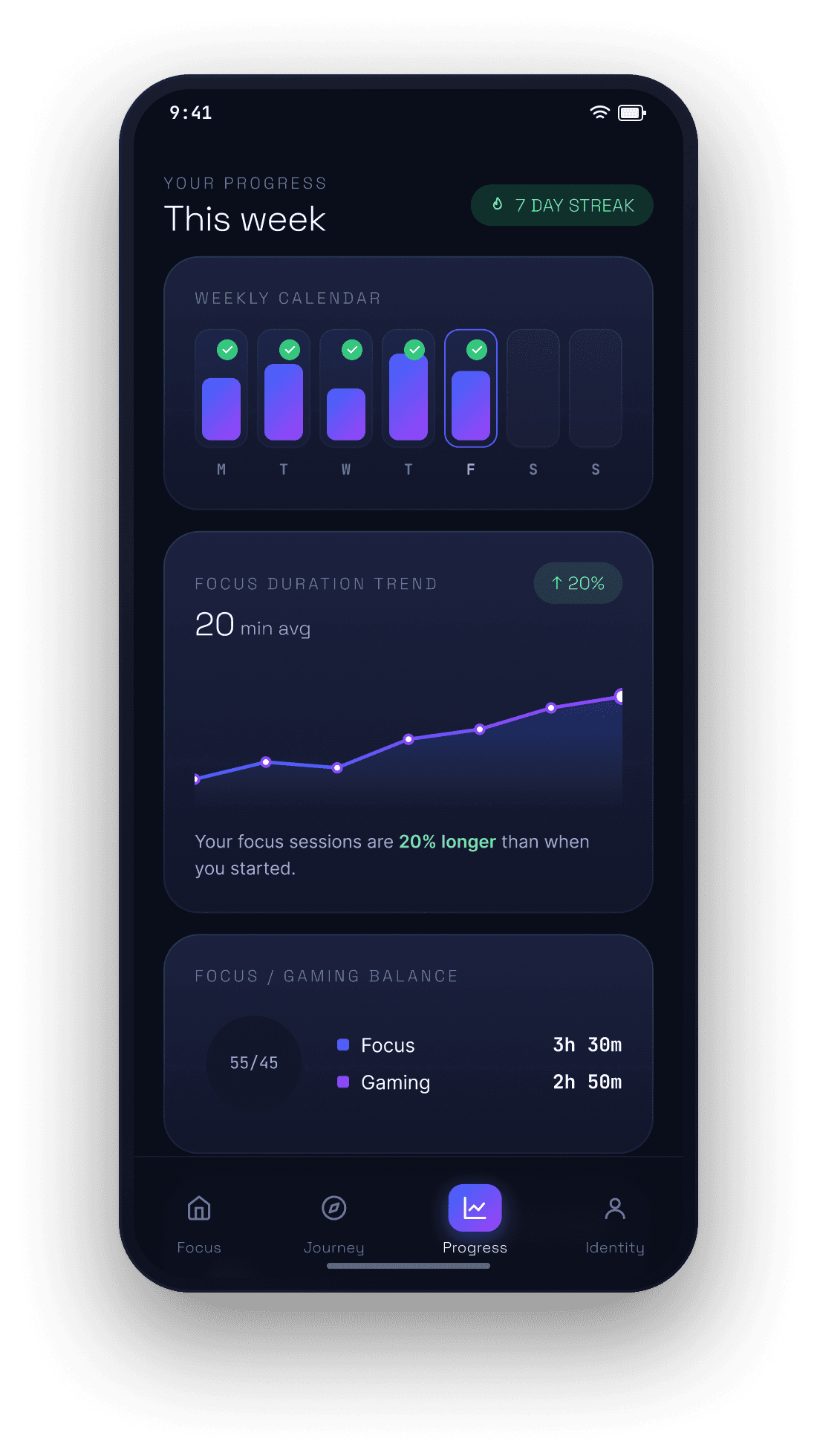
5-min sessions to 30-min mastery, the RPG arc made visible

Focus Journey Map Screen

Week 3 - Progression State Screen

Week 3
Progression State Screen

Progress Dashboard Screen

Week 12 - Mastery State Screen

Week 12
Mastery State Screen

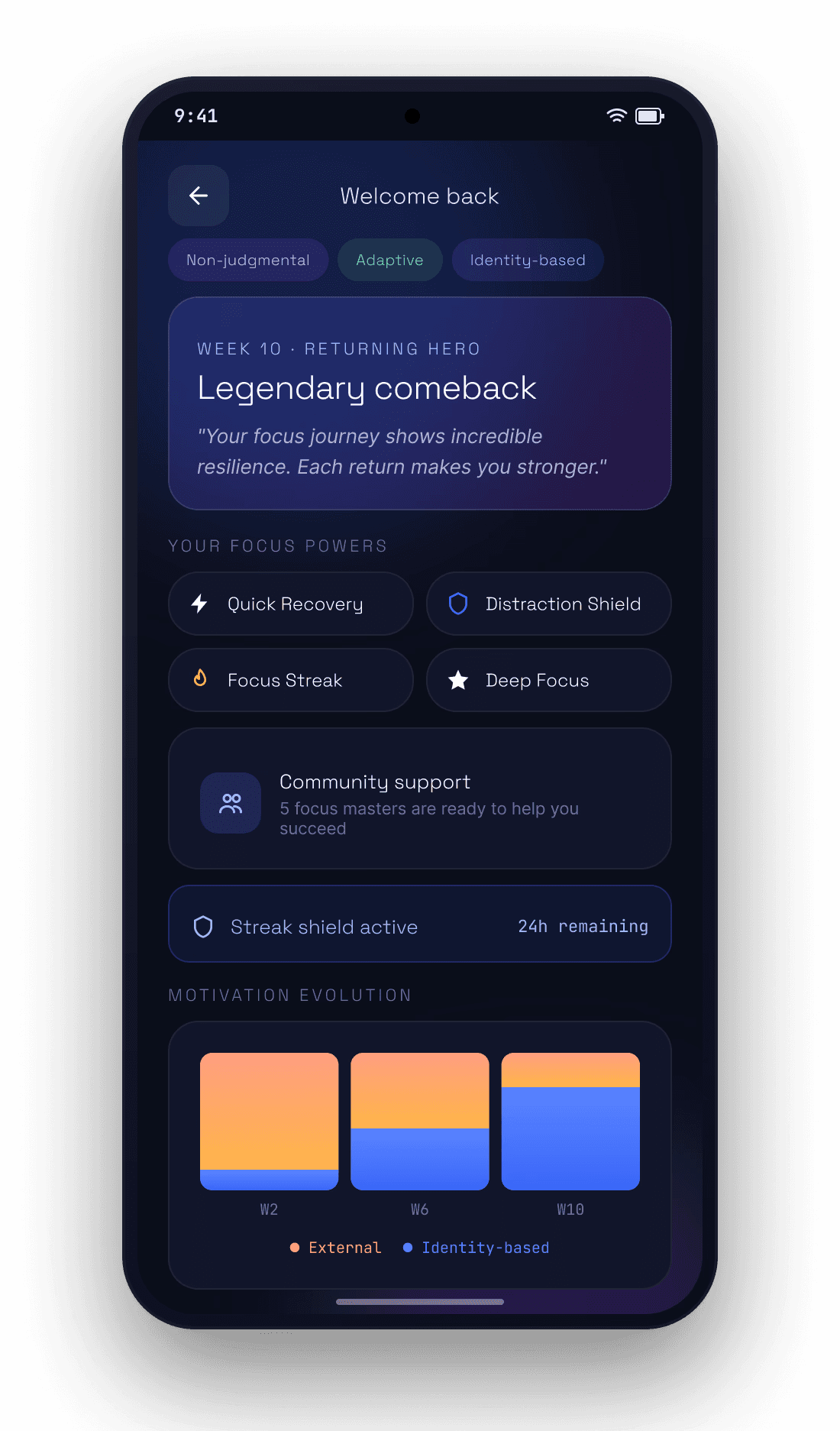
{04} — The Comeback Journey

The non-happy path: lapses handled without shame, privacy granular from day one.

Clear pathway (not permanent setback)

Clear pathway
(not permanent setback)

"Comeback Quest" framing

Celebrates return (learning, not shame)

IMPACT & RESULTS

IMPACT & RESULTS

IMPACT & RESULTS

Retained. Improved. Preferred

58
58
58
58

Classroom Focus Improvement

Skills transferred beyond app (teacher reports)

Skills transferred beyond app (teacher reports)

Improved

0
0
0
0

Improved Parent-Teen Trust

Autonomy-supportive (not control-based)

Validated

45
45
45
45

Preferred Identity Verification

Users chose reflection question over camera monitoring

Users chose reflection question over monitoring

Preferred

Increase in Sustained Focus Duration

From 5-min baseline to 25-30 min sustained sessions, demonstrating that graduated challenge (personalised starting points) builds capability over time

5 min

Week 1

15 min

Week 4

20 min

Week 8

30 min

Week 12

Motivation Shift Over Time

GAMING REWARDS

GAMING REWARDS

MIXED MOTIVATION

MIXED MOTIVATION

FOCUS SATISFACTION

FOCUS SATISFACTION

CROSSOVER

CROSSOVER

High

High

Mid

Mid

Low

Low

Week 1

Week 1

Week 4

Week 4

Week 8

Week 8

Week 12

Week 12

Beyond

Beyond

Gaming Motivation

Gaming Motivation

Focus Satisfaction

Focus Satisfaction

At first I thought it was stupid… Now I don't even think about the gaming time, I just like being able to concentrate.

— Participant, Age 16 (Week 10 reflection)

Users chose reflection question over monitoring

Lets

design

build

create

Something Impactful

Lets

design

build

create

Something Impactful